
[This article used to be published on the blog section of http://www.therenewery.de, the website of an upcycling label that no longer exists. That’s why it will be featured here in full length from 1.1.23.]
“Second-hand clothes stink.”
“My friend once got lice from a hat that she had bought second-hand.”
“I wouldn’t want to wear something that has been worn before.”
“Vintage stores never carry my size.”
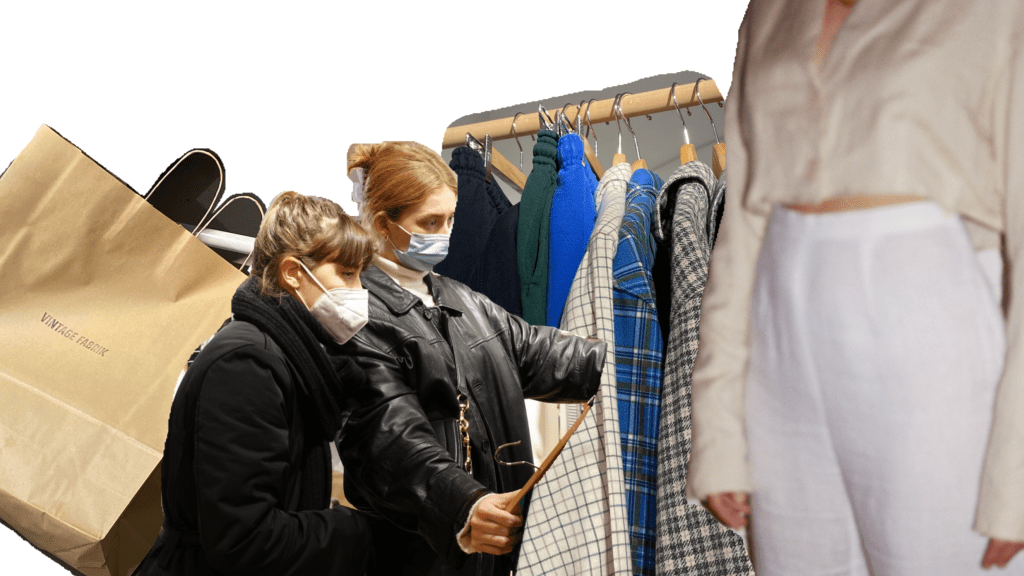
I oftentimes come across certain stereotypes surrounding pre-owned clothing that seem to be stuck in people’s minds. As all other clothing, you should wash pre-owned clothes before you wear them. But for the most part, I can’t understand that the fact, that someone might have worn/used something before them, disgusts people.
Our friend Eva from Elfenbeinturm Magazine has shifted our focus to this topic when she asked us the same question in an interview (read it here).
“The question didn’t only made me think of environmental and ethical reasons but also personal reasons that make second-hand goods important to me.”
Here’s what I wish people who have never bought second-hand knew.
ENVIRONMENTAL IMPACT
We are living in a society where the majority of people in the global north are fortunate enough to own everything in abundance.
“Quoting a recent UN report, the fashion industry is responsible for 10% of all global greenhouse gas emissions (that is worse than the combined climate footprint of all means of transport). ”
But big companies still push production to new limits to manufacture goods that no one actually needs. If we get more familiar to utilizing existing resources and to viewing our economy as circular rather than linear, we could significantly minimize our climate food print.
ETHICAL REASONS
No matter how irrelevant our buying decisions may seem, we as consumers have a crucial impact on how brands pursue their future production. Your choice to say no to the current system and its poor working conditions may enable future workers to be treated better.
Have you ever thought about why fast fashion brands can ensure to sell a pair of jeans for 9 euros and still make billions?
“Most times, it’s the people in clothing production paying human cost to make up for the cheap price consumers want to pay for textiles.”
If you want to inform yourself more about the environmental and ethical reasons for abandoning fast fashion, you could start by watching the Netflix documentary “The true cost” or follow accounts like @fash_rev or @thesustainablefashionforum on Instagram.
DEVELOPING PERSONAL STYLE
When we were younger, a lot of us likely bought clothes just because they were on trend and everybody wore them. And while that was completely fine back then, we may now realize that it’s not even desirable to resemble everyone around you. Do you know the feeling when someone walks by you in the street wearing the same jacket as you?
I like to think of myself as unique (everyone probably does to some degree). I don’t necessarily force to be perceived as having a unique style but it is somehow important to me that my appearance reflects how I like to be understood as a person.
“That is why I now invest into timeless pieces that mirror my personality rather than buying pieces because they are fashionable.”
It was only really through vintage and second-hand clothing that I was able to develop a more unique and personal style. Sometimes I still get sucked into trends, but only if they match what I would typically wear anyways.
THE REWARDING FEELING OF FINDING TREASURES
Continuing with the aspect of uniqueness, it is almost needless to say that vintage clothing is more unique since there is literally only that one piece. That is why it is so much more rewarding to me to find something that matches your style and your size. You should know the feeling of having looked for the perfectly fitting pair of vintage jeans for months only to then try them on and never wanting to put them off again. You will feel so special wearing this piece knowing the time and effort that you have put into getting it.
THE CONTINUOUS CYCLE OF TRENDS
If buying trendy pieces is important to you, look into second-hand platforms like Vinted where private people sell their clothing. Often times you will find pieces from current collections for a cheaper price that haven’t even been worn.
“Also trends work in a continuous cycle. ”
Pieces like sweater vests, high waisted mom jeans or certain colors are aspects that have already been trendy in fashion at some point. So for almost every trend, you will find pieces from past decades that have already been produced while the same trend was going on.
PRICE-PERFORMANCE RATIO
If you buy clothing from past decades, they are usually of much higher quality than clothing that would be produced nowadays. This oftentimes even applies to fast fashion brands like H&M or C&A whose quality wasn’t always as poor as it is now. As a rule of thumb, I’d say clothing produced before the turn of the millennium is usually much more long-lasting.
Saving money can also be an important motivator for buying pre-owned goods since they are typically much more affordable. Bringing these two aspects together, the ratio of price to quality is really notable in second-hand goods.
I hope that this love letter to second-hand fashion shows you how meaningful and enriching it can be to shop second-hand. Maybe you can neglect some of the stereotypes that have been stuck in your mind and just give it a try.
 Hannah Ernst
Hinterlasse einen Kommentar